
Criminal Court Cases in Onondaga County
Onondaga County criminal cases do not all begin and end in one court. Syracuse City Court hears city misdemeanors and violations, and it conducts arraignments on felony complaints. A felony arraignment is the first court event, not the felony trial. After a grand jury returns an indictment, the case usually moves to Onondaga County Court. New York Supreme Court also has general criminal jurisdiction and may hear assigned felony matters. Outside Syracuse, the town or village justice court handles local misdemeanors, violations, and preliminary felony proceedings.
The clerk of the court where the case is pending keeps its docket. For Syracuse City Court criminal questions, call 315-671-2760. The Onondaga County Court criminal line is 315-671-1020, and the Supreme Court clerk is 315-671-1030. A docket number is the strongest locator. When it is unknown, supply the full legal name, approximate filing or arraignment date, and the municipality where the charge arose.
Onondaga County Court Locations
Several justice offices sit close together in downtown Syracuse, yet they serve different record needs. The Honorable James C. Tormey III Criminal Courthouse at 505 South State Street houses Syracuse City Court criminal functions and Onondaga County or Supreme criminal work. The clerk counter is the right destination for a docket, case status, copy procedure, or certificate of disposition.
The Patrick J. Corbett Justice Center at 555 South State Street deals with custody, release, bail, and jail administration. It is not the court-record counter. The historic County Courthouse at 401 Montgomery Street contains the public law library, which can help readers find statutes and official forms but cannot give legal advice. Court visitors should expect security screening. Ask the clerk in advance about language access, accessibility support, electronics, and recording rules.
Criminal Courthouse
505 S. State St.
Syracuse, NY 13202
County Court: 315-671-1020
Weekdays, 8:30 a.m. to 4:30 p.m.
City Court Criminal Clerk
505 S. State St.
Syracuse, NY 13202
315-671-2760
For city misdemeanors and felony arraignments
Onondaga County Case Record Searches
WebCriminal Defendant Search is the free statewide starting point for pending criminal cases and future court appearances. It does not promise every document image, disposed case, sealed matter, or complete historic town and village coverage. A precise name and a county or court filter reduce false matches. A known docket number is better still.
- Open WebCriminal, accept its terms if prompted, and choose the defendant-search mode.
- Enter the legal last and first names. Try punctuation or known spelling variants when a result is absent.
- Narrow the search to Onondaga County and the likely court, or use a known docket number.
- Read the charge, court, status, and next appearance together. Do not treat a pending charge as an outcome.
- Contact the listed clerk for copies, nonpublic online documents, or an official certificate of disposition.
| Field Label | Type | Required | Notes |
|---|---|---|---|
| Last Name | Text | Yes for name route | Use legal spelling; variants can matter |
| First Name | Text | Usually | A middle name or initial can help separate matches |
| County | Dropdown | No | Select Onondaga to narrow local cases |
| Court | Dropdown | No | Choose County, Supreme, City, or local court as indexed |
| Case or Docket Number | Text | No | Best route when the exact number is known |
Onondaga County Court Search Gaps
WebCriminal and OCA Criminal History Record Search, called CHRS, answer different questions. WebCriminal centers on pending cases and scheduled appearances. OCA CHRS Direct Access is a paid, exact name and date-of-birth search across public open cases and convictions reported by courts in all 62 counties. The fee is $95 for each search. Name or birth-date variations are not reported, sealed cases are left out, and the product is not certified.
Town and village court history is the key Onondaga County limitation. Reporting coverage varies over time, so a negative CHRS result is not conclusive for an older local matter. Contact the justice court that made the record. If proof of one outcome is needed, request a certificate of disposition from that clerk rather than relying on a portal printout.
Note: A certificate of disposition is the clerk's official account of one case and carries more weight than an index screen.
What a Criminal Case File Contains
An Onondaga County criminal case file follows the litigation, not merely the arrest. It can identify the accusatory instrument, judge, attorneys, court dates, motions, pleas, verdict, disposition, and sentence. An accusatory instrument is the complaint, information, or indictment that formally alleges an offense. Public WebCriminal results may summarize parts of that history, but document images are not assured. The clerk controls access to the official file.
| Case Number & Court | Identifies the docket and the clerk that maintains it. |
|---|---|
| Charging Document | Shows the complaint, information, or indictment and the filed statutes. |
| Docket Entries | Chronological record of appearances, filings, motions, pleas, and rulings. |
| Hearing Dates | Lists past events and a future date, part, or judge when entered. |
| Disposition & Judgment | States the outcome for each charge, such as conviction, dismissal, or acquittal. |
| Sentence & Conditions | Records the court's consequence after conviction, including custody, probation, fines, restitution, or conditions where applicable. |
The docket should be read as a timeline. A future appearance is not a disposition, and a charge line is not proof of conviction. When an entry is unclear, use the docket number and date when asking the clerk what public document explains it.
Onondaga County Court Dispositions
Charge labels can change as an Onondaga County case moves. The arresting agency records the suspected offense. A prosecutor may decline it, reduce it, replace it, or add another count. A grand-jury indictment can differ from the first felony complaint. The final disposition then states what happened to each filed charge. That outcome controls whether the record shows a conviction, dismissal, acquittal, or another status.
- Disposition
- The recorded result or current status of a charge or case.
- Dismissal
- Termination of a charge without a conviction on that charge.
- Acquittal
- A not-guilty verdict, which is not a conviction.
- Plea
- The defendant's formal response, including guilty or not guilty.
Read the statute, charge class, and disposition on the same line. A booking charge by itself cannot establish what the court later filed or decided. The distinction is also why the county Arrest Search and the court docket serve different purposes.
Criminal Case Stages in Onondaga County
After charges are filed, arraignment addresses the allegations, counsel, and release or remand. A felony complaint may go before a grand jury. An indictment then moves the prosecuted felony into County or Supreme Court and brings a new arraignment on that instrument. Discovery and motions occur before a plea or trial. A guilty plea or verdict leads to sentencing. Dismissal or acquittal is a favorable result and normally triggers sealing under New York law.
Case flow: Charges Filed › Arraignment › Pretrial › Plea or Trial › Disposition › Sentencing
An appeal reviews claimed legal error after judgment. It is separate from the trial and does not erase the lower-court docket. Each stage may create a new entry, order, or document, so the current status should be read with the entry date.
Onondaga County Specialty Court Dockets
The Fifth Judicial District lists Adult Drug Treatment Court, Mental Health Court, Veterans Court or Track, Emerging Adult Domestic Violence Court, and Sex Offense Court functions in Onondaga County. These supervised court programs can explain a specialized calendar or case-handling path. They are not separate public criminal-history databases.
Syracuse Community Treatment Court operates in Room 117 of the John C. Dillon Public Safety Building at 511 South State Street, not in the Criminal Courthouse. A public docket may reveal court events, but treatment, health, and protected participant material does not become open merely because a case uses a problem-solving calendar. Ask the assigned clerk what can lawfully be inspected.
Access Rules for Case Records
Judiciary Law §255 directs court clerks to search and certify records upon a lawful request and payment of required fees, subject to sealing and confidentiality. Public access does not extend to sealed cases, youthful-offender records, grand-jury material, or protected victim data. An online index can show less than the paper file, and some filed records may be redacted.
Favorable terminations generally seal under CPL 160.50. Other statutes cover eligible violations, certain drug cases, application-based sealing, and Clean Slate automatic sealing. Clean Slate took effect in 2024, but the court system has through November 16, 2027 to complete implementation. A missing public result may reflect sealing, jurisdiction, reporting history, or indexing delay.
The Unified Court System's Clean Slate information provides the official implementation context for Onondaga County criminal case records.
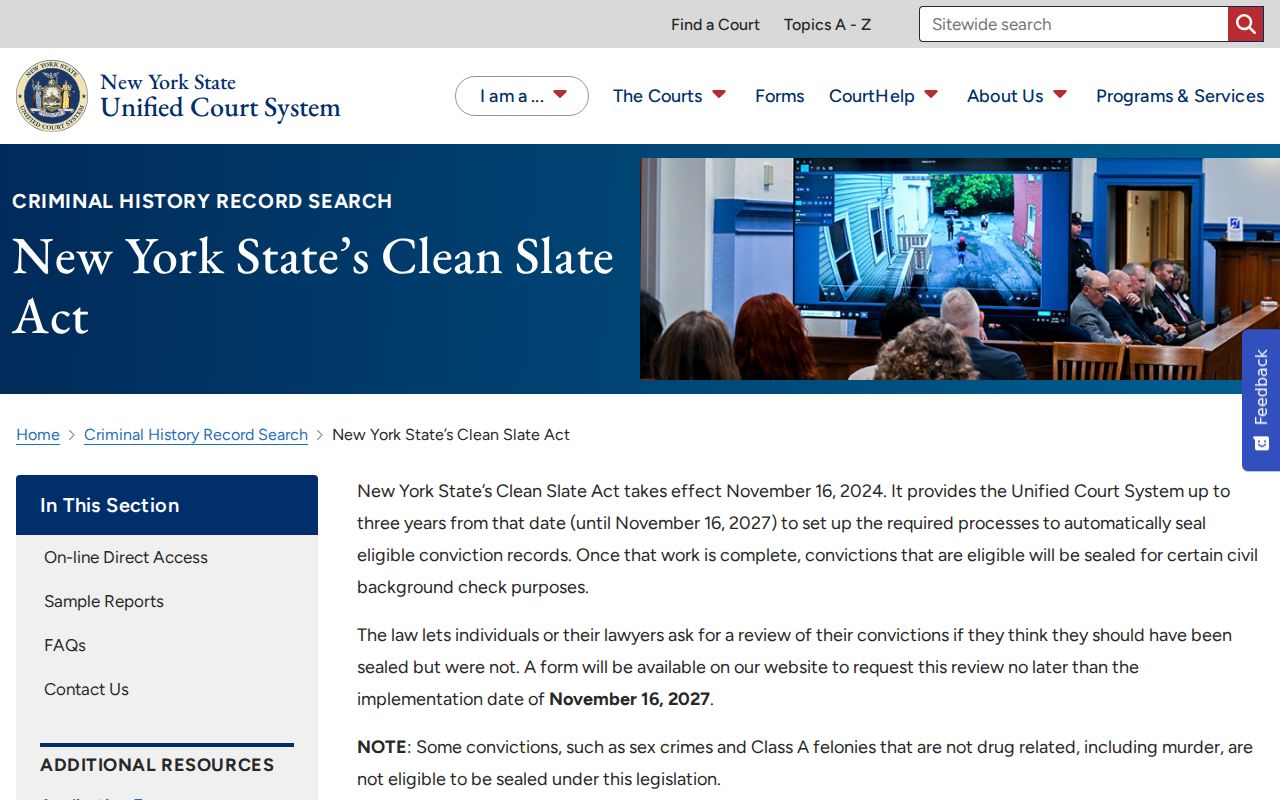
The official material helps distinguish a case that is sealed by law from one that is merely absent from a portal search.
Federal Onondaga County Court Cases
A federal criminal case arising in Onondaga County does not appear as a County Court prosecution. The Northern District of New York serves the area from the James M. Hanley Federal Building and U.S. Courthouse at 100 South Clinton Street in Syracuse. Search those dockets through PACER, not WebCriminal.
PACER permits searches by court, case number, party name, case type, and date range after login. It charges 10 cents per page, caps most single documents at $3, and waives quarterly fees when usage is $30 or less. Sealed and redacted material remains unavailable. The official federal portal illustrates the distinct search layer.
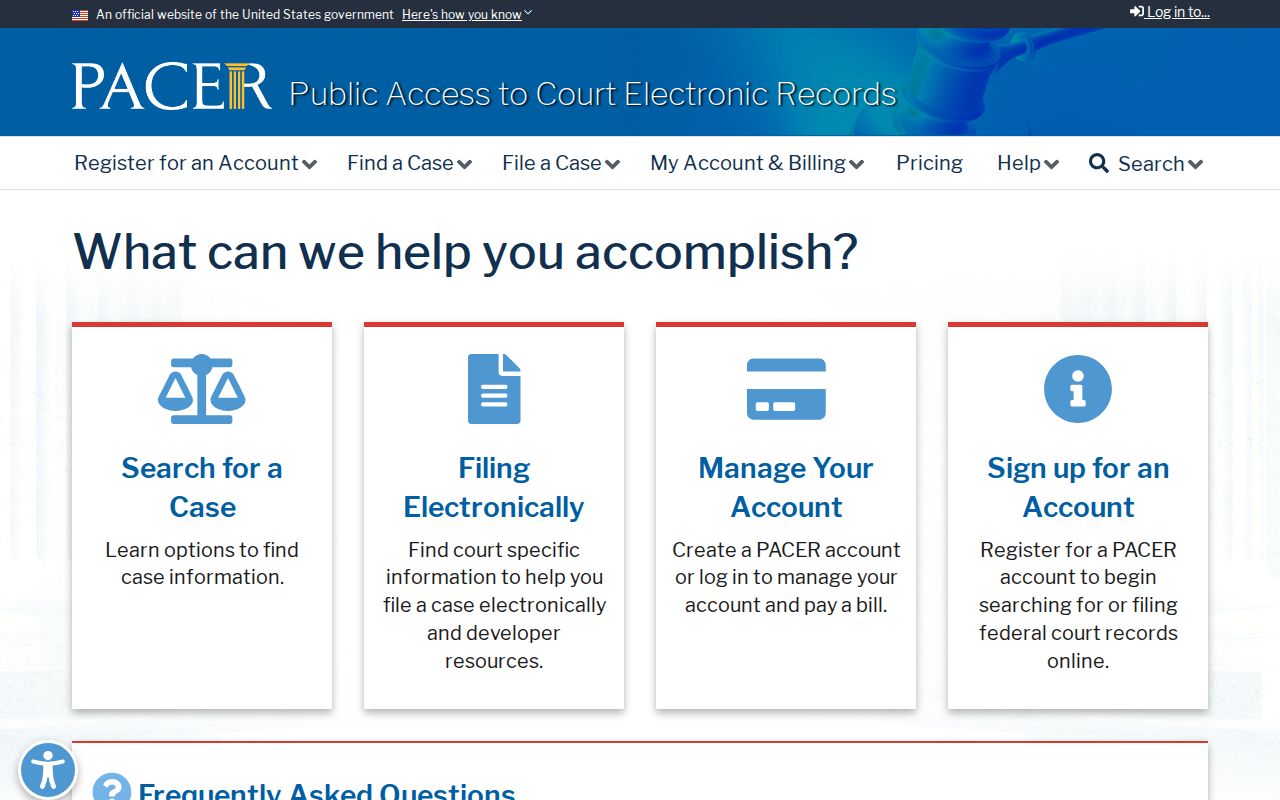
Use the court and case number from PACER when requesting a federal filing or asking the Northern District clerk about access.