
Onondaga County Sex Offender Checks
The New York State Sex Offender Registry is the main official source for an Onondaga County lookup. The New York State Division of Criminal Justice Services, or DCJS, maintains it under the Sex Offender Registration Act. A court sets a person's risk level after a hearing. Level 2 means moderate risk and Level 3 means high risk. Both appear online. Level 1 means low risk and is handled by telephone rather than the public web directory.
Begin with the online directory when the goal is a public county list or a Level 2 or Level 3 name search. Call 800-262-3257 for a Level 1 inquiry or an individual whose level has not been set. The caller must provide the name plus an exact address, date of birth, driver-license number, or Social Security number. For Level 1, DCJS limits address information to the ZIP code. Staff answer that line from 8 a.m. to 4 p.m. on weekdays other than legal holidays.
The official DCJS registry landing page shows how New York separates public web access from telephone verification.
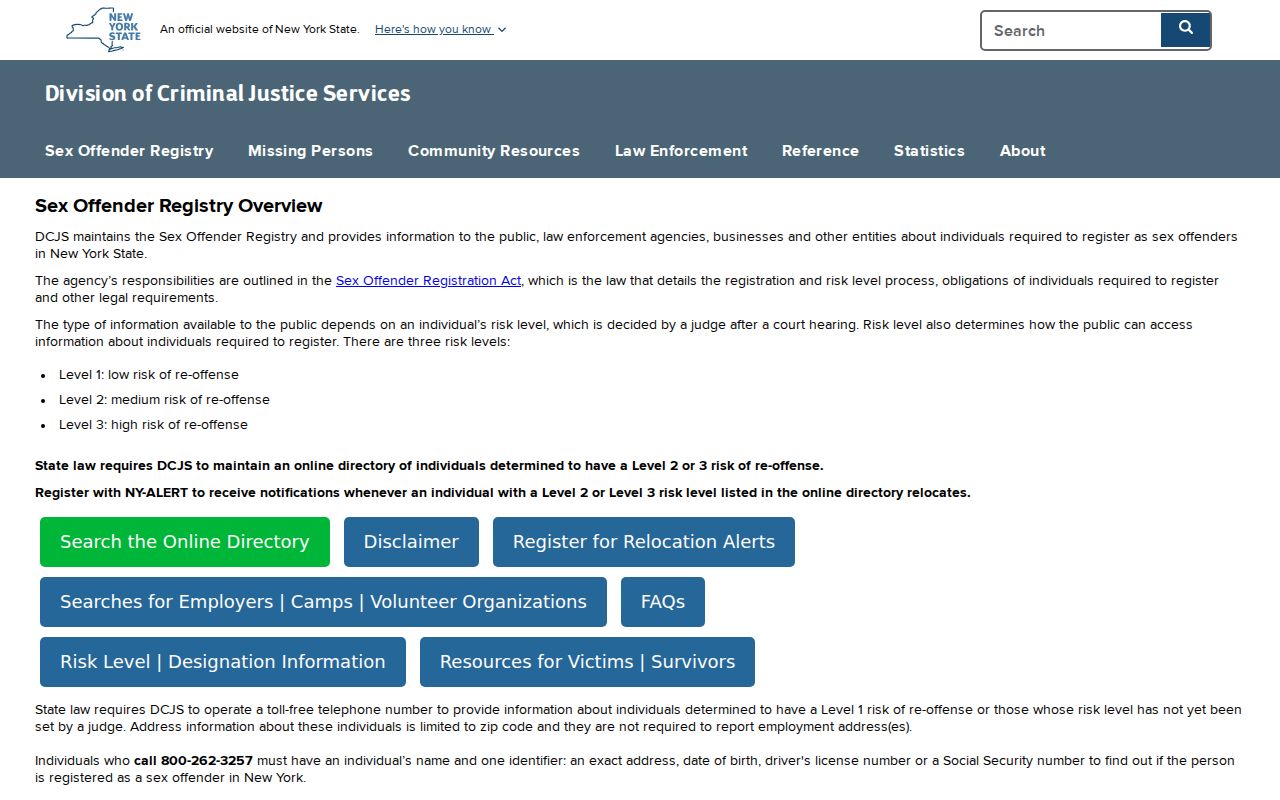
This state entry point is the right place to confirm current scope, risk-level rules, and search options before relying on a result.
Onondaga Registry Level 1 Route
A blank online result does not prove that no New York registration exists. Level 1 registrants are not displayed in the public online directory. Historical limits and cases in which the risk level has not yet been set can also affect what a user sees. The telephone route fills part of that gap, but DCJS requires an identifier in addition to the person's name. This safeguard reduces the risk of disclosing information about the wrong person.
Name-only matching can still mislead when several people share a common name. Use the returned ZIP code, age or date of birth, physical traits, and other official identifiers as a set. Do not treat a name as a unique key. If the online directory and telephone response seem inconsistent, contact DCJS at 518-417-3384 or SORRequests@dcjs.ny.gov rather than confronting the person named in a result.
Note: The Level 1 telephone route supplies limited public information and is not a substitute for access to a confidential criminal-history file.
New York State Sex Offender Registry Searches
The registry form supports name and location-based ways to narrow an Onondaga County search. It does not promise fixed-radius options around a street address. Search broadly first, then use verified identifiers to distinguish results.
- Open the official DCJS directory and review its use notice.
- Enter a last name, then add a first name when known, or choose Onondaga from the county list.
- Use a five-digit ZIP code as an alternate geographic route.
- Open a likely profile and compare the photograph, aliases, physical details, address, and conviction data.
- Use the DCJS phone line when Level 1 or pending-level information is needed.
| Field or control | Use | Format note |
|---|---|---|
| Last Name | Main name search | Do not assume partial-name behavior |
| First Name | Narrows a name search | Optional |
| County | Creates a county list | Select Onondaga |
| ZIP Code | Alternate geographic search | Five digits |
| Search | Runs the query | Required to submit |
| Relocation alerts | Opens NY-ALERT enrollment | Optional |
The official search form illustrates the fields available for an Onondaga County registry lookup.
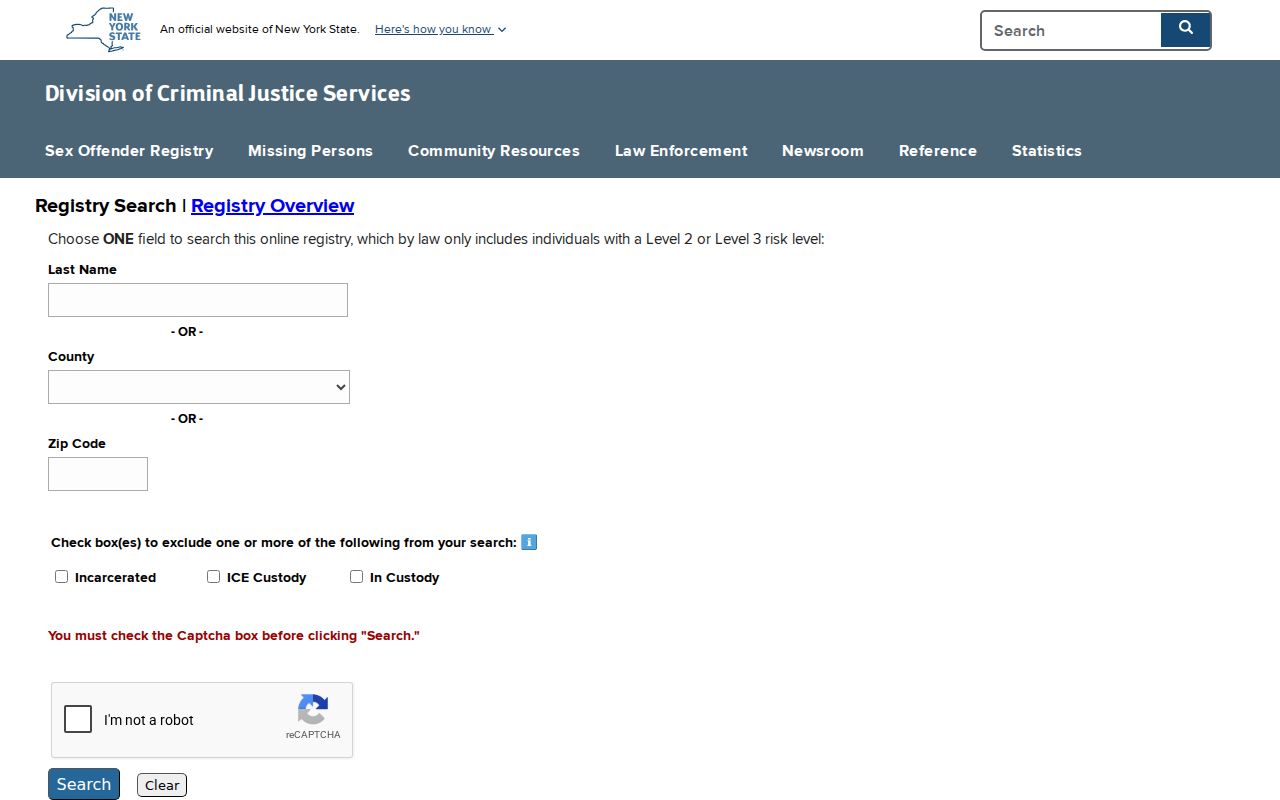
The interface confirms that county, ZIP, and name searches are distinct paths rather than a promised street-radius search.
Onondaga Sex Offender Alerts
NY-ALERT can notify subscribers when an online Level 2 or Level 3 registrant relocates. It is useful for ongoing community awareness, while the directory remains the source for reviewing the profile itself. An alert can prompt a fresh check, but it should not be treated as proof that every registrant in an area has been listed. Level 1 records remain outside the online directory.
The Onondaga County Sheriff's Office has a local registration and compliance role. Call 315-435-3044 before visiting Sheriff Headquarters at 407 South State Street because the research did not identify a separate public registration counter, posted hours, or a public fee. Suspected noncompliance belongs with local law enforcement or DCJS. Use 911 only for an emergency, and never attempt personal enforcement.
Registry Profiles: What They Show
A public profile joins several identifiers with court and registration facts. Read the entire entry. A picture may be more useful than a name, while aliases and physical marks help separate people with similar names. Conviction details identify the registerable offense and jurisdiction. Risk level reflects a New York judicial classification, not the federal SORNA tier system.
| Identity | Name, aliases, and photographs when available |
|---|---|
| Classification | Risk level and any predator, sexually violent offender, or predicate designation |
| Description | Physical traits and identifying marks where reported |
| Location | Public residence information for Level 2 and Level 3 |
| Conviction | Registerable crimes, jurisdiction, and conviction details |
| Vehicles | Make, model, and plate when supplied |
| Status | Compliance or update details when the interface provides them |
A neutral crop from the official registry profile layout shows how DCJS groups public fields without reproducing a registrant's identity here.
The layout makes clear why the photograph, level, conviction, address, and update details should be checked together.
Onondaga and National Registry Results
The National Sex Offender Public Website, or NSOPW, searches public registry data contributed by many jurisdictions. It adds value when a person may have moved across state lines or when an address is close to another state. Each state still controls the information it contributes, so a national result does not erase New York's own visibility rules.
Use DCJS for the New York risk level and state-specific profile. Use NSOPW as the cross-state layer. If the two displays differ, compare update dates and return to the agency that owns the record. Neither source turns a shared name into a confirmed identity without further matching.
The U.S. Department of Justice national search presents that wider multi-jurisdiction entry point.
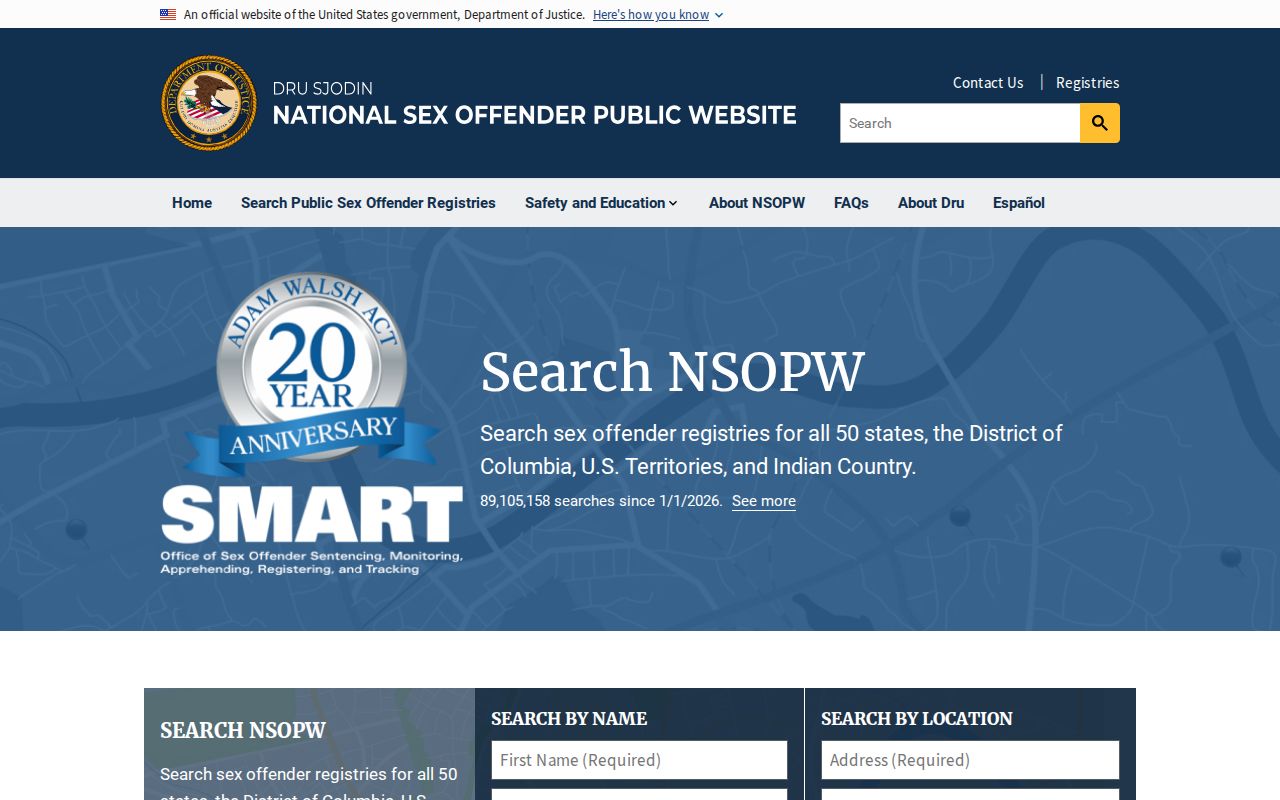
This broader search is best used beside the New York directory, not as a replacement for it.
Registration Levels and Duties in New York
New York's numeric level measures risk of repeat offense as set by a judge. A separate designation can affect lifetime duties. The often repeated claim that every Level 1 registration ends after ten years is outdated. Current SORA rules generally use 20 years for a Level 1 person without a lifetime designation, while Level 2 and Level 3 registration is generally for life, subject to the statute and any available petition process.
| Level or designation | Public visibility | General duration |
|---|---|---|
| Level 1, low risk | Telephone verification, not online | Generally 20 years without a lifetime designation |
| Level 2, moderate risk | Online directory | Life, subject to statutory rules and petition mechanisms |
| Level 3, high risk | Online directory and broader notice | Life |
| Qualifying court designation | Consistent with the public risk level | Life |
Verification and in-person reporting can also be triggered by a change in residence, internet identifiers, or vehicle information. Exact duties depend on the order, risk level, designation, and current law, so the individual profile and DCJS guidance matter more than a generic duration claim.
Onondaga Registry and Supervision
A registry profile may state parole or probation conditions, but registration and community supervision are different systems. Onondaga County Probation oversees local probation sentences. The New York State Department of Corrections and Community Supervision handles parole and post-release supervision. A registry classification does not by itself reveal every supervision term or current custody fact.
The DOCCS Parolee Lookup is the official public channel when state supervision status is relevant.
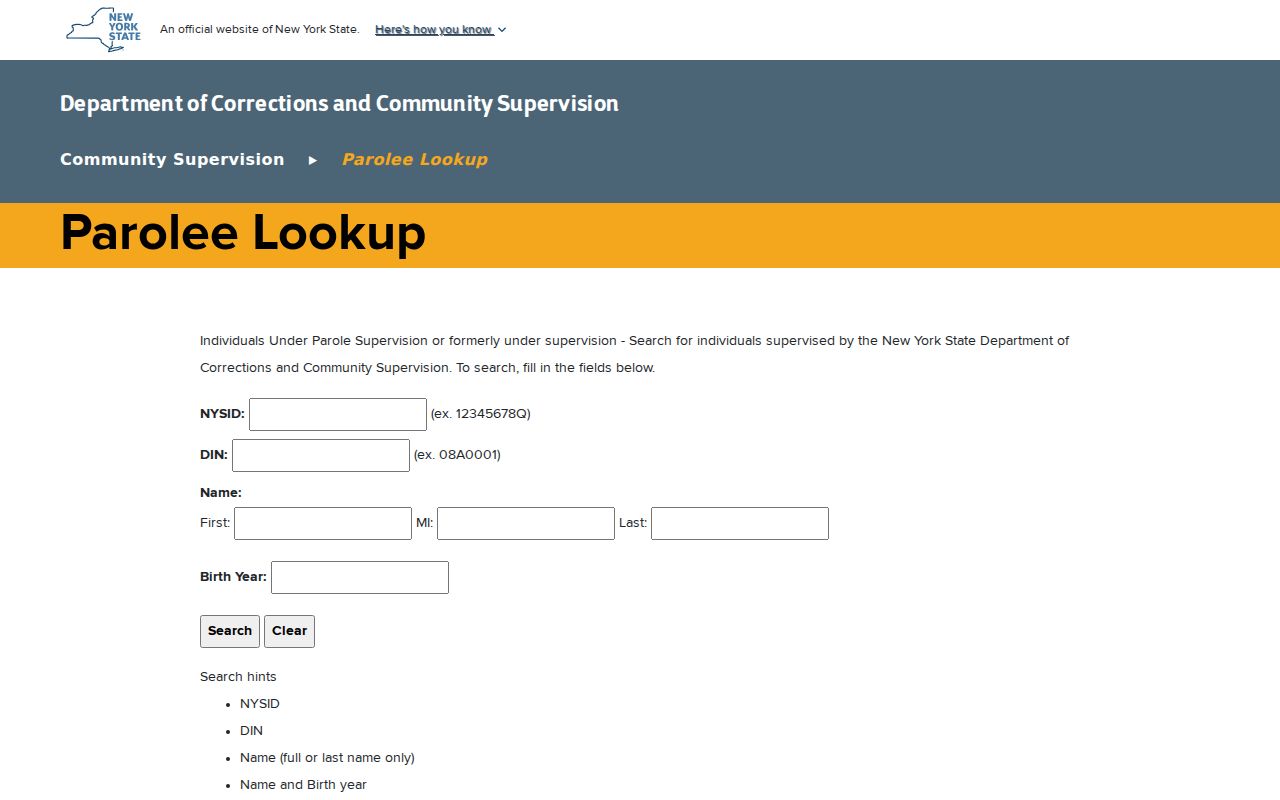
The separate DOCCS interface reinforces a key boundary: a registry result and a parole status answer different questions.
When Onondaga Registry Results Differ
If no result appears, check the spelling and use the county and ZIP routes. Then consider the Level 1 telephone process and the directory's historical limits. If a likely match does appear, confirm it with more than a name. Compare the photo, age, physical description, address, aliases, conviction jurisdiction, and update information.
Older listings can also reflect due-process and litigation limits. A missing online entry does not establish noncompliance, and a listed person should not be approached. Report a suspected failure to register to DCJS or the appropriate police agency with the facts that support the concern. That method protects the caller, preserves evidence, and leaves verification to trained staff.
Using Registry Information Lawfully
Registry information exists for safety and community awareness. It can help a family recognize an official notice, compare an identity, or choose reasonable safety steps. It is not permission to punish, exclude, stalk, publish private data, or interfere with a household. A registry record should also be read as the state's current public classification, not as proof of a new offense.
SORA misuse warning: New York's Correction Law Article 6-C governs registry disclosure. Threats, intimidation, harassment, and other illegal misuse of registry information can be crimes and may undermine law-enforcement work.
When a safety concern involves suspected noncompliance, save the relevant official details and report them. Call 911 only when danger is immediate. For a routine question, use DCJS or the Onondaga County Sheriff. Calm verification is safer and more reliable than confrontation.